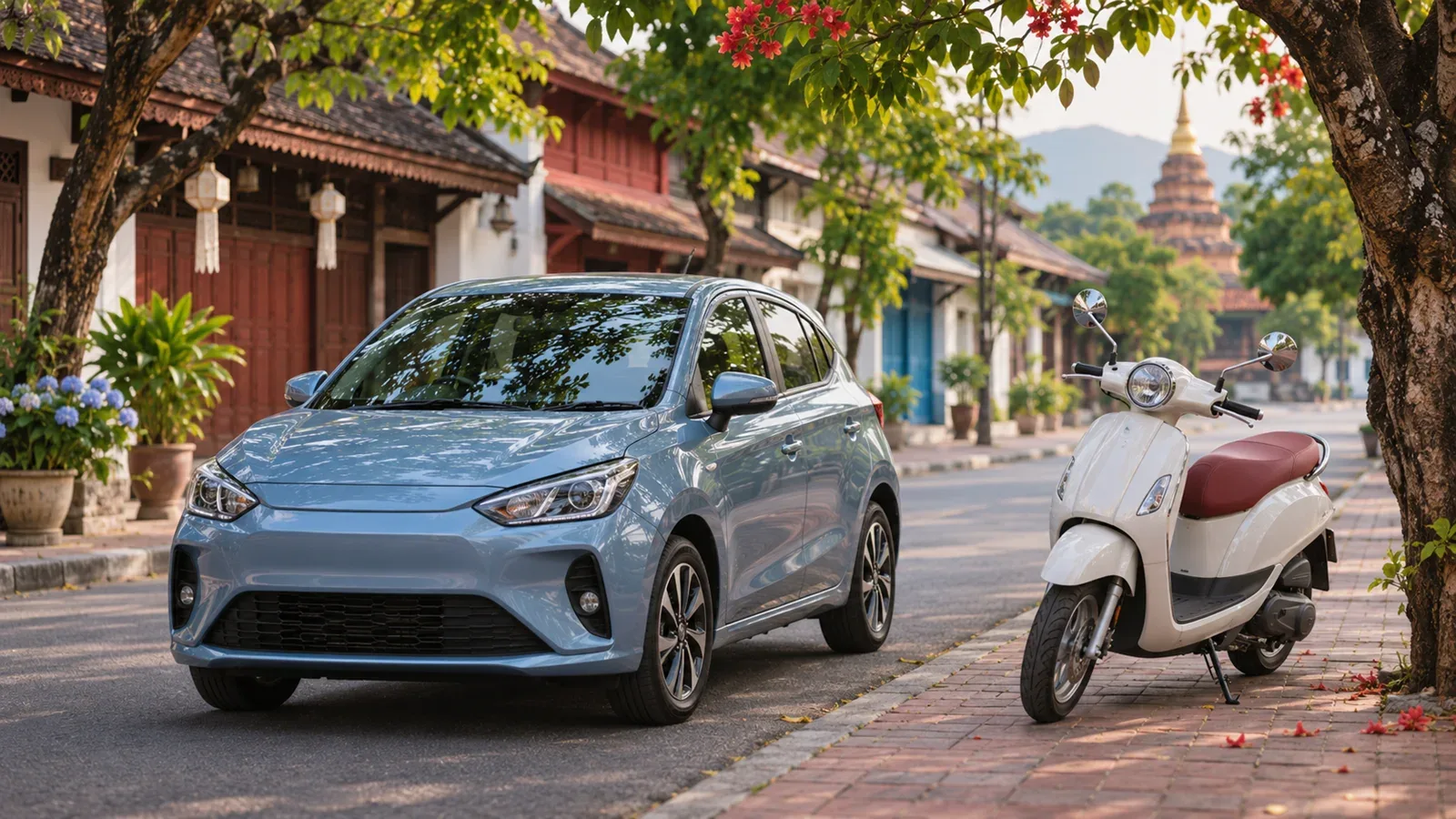
Car insurance in Thailand works in two layers. Every car and motorbike must carry the compulsory insurance, called Por Ror Bor, which only pays for injury and death. To protect your own car, other people's vehicles and property, or against theft and fire, you add a voluntary policy in Class 1, 2+, 3+, 2 or 3. Foreigners can buy both, as long as the vehicle is properly registered and every driver holds a driving licence that is valid in Thailand.
This guide explains what each class covers, what you need as a foreigner, what makes the premium go up or down, how to claim after an accident, and how motorbike insurance fits in. You can then compare offers for your exact make, model and year online.
What is compulsory car insurance (Por Ror Bor) in Thailand?
Por Ror Bor (พ.ร.บ.) is the compulsory motor insurance required by Thai law for every registered vehicle, from a small scooter to a pickup. It is inexpensive, it is sold by every motor insurer and often at the counter where you renew the annual road tax, and you cannot renew that tax without it. Driving without valid compulsory insurance is an offence.
What it does:
- Pays medical expenses and compensation for bodily injury, disability or death caused by the vehicle, for the driver, passengers, people in the other vehicle and pedestrians.
- Pays an initial amount for medical costs before fault is decided, so injured people can be treated quickly.
- Pays more once the investigation shows who was at fault, up to the limits set by law.
What it does not do: it never pays for damage to your car, to the other car, to a wall or a shop front, and it does not cover theft or fire. The legal limits are also modest compared with the cost of a serious accident at a private hospital. That is why most drivers, and almost every owner of a financed car, add a voluntary policy on top.
Good to know: the amounts Por Ror Bor pays are fixed by regulation and change from time to time. Check the current figures on the insurer's schedule or with the Office of Insurance Commission rather than relying on numbers quoted on forums.
What do Class 1, 2+, 3+, 2 and 3 car insurance cover?
Voluntary car insurance in Thailand is sold in standard classes. The class name tells you which events are covered; the limits, deductible and extras then vary by insurer and plan. Here is what each class usually covers:
| Cover | Por Ror Bor (compulsory) | Class 1 | Class 2+ | Class 3+ | Class 2 | Class 3 |
|---|---|---|---|---|---|---|
| Injury or death of people | Yes, basic legal limits | Yes, above Por Ror Bor | Yes, above Por Ror Bor | Yes, above Por Ror Bor | Yes, above Por Ror Bor | Yes, above Por Ror Bor |
| Damage to other people's vehicles and property | No | Yes | Yes | Yes | Yes | Yes |
| Your car, collision with another land vehicle | No | Yes | Yes, other party identified | Yes, other party identified | No | No |
| Your car, accident with no other vehicle (pole, wall, ditch) | No | Yes | No | No | No | No |
| Theft of your car | No | Yes | Yes | No | Yes | No |
| Fire | No | Yes | Yes | No | Yes | No |
| Flood | No | Usually yes | Depends on the plan | Rarely | Rarely | No |
| Driver and passenger accident and medical riders | Basic only | Usually included | Usually included | Often included | Often included | Often included |
A few points the table cannot show:
- "Other party identified" means that for Class 2+ and 3+ your own car is only repaired after a crash with another land vehicle whose plate or driver is known. A hit-and-run, a dog on the road or a fall into a ditch is not covered.
- Class 1 is the only class that covers damage you cause alone, which is a real risk on unfamiliar roads, in heavy rain or in tight condo car parks.
- The plus classes were created as a middle ground: much of the protection of Class 1 for collisions, without paying for single-vehicle accidents.
Which class should you choose?
There is no single best class. A practical way to decide is to ask what would hurt your budget most:
- A new or recent car, or a car on finance: Class 1. Lenders usually require it, and a single-vehicle accident or a flood would otherwise be at your own expense.
- A car a few years old that you still want repaired after a crash: Class 2+ is the common choice. Add flood cover if you live in an area that floods.
- An older car with a low market value: Class 3+ or Class 2. You keep protection against the costly part, the damage you might cause to others, and against collisions or theft depending on the class.
- An old second car used rarely: Class 3 at minimum. Por Ror Bor alone leaves you personally exposed to the other party's repair bill, which can be large if you hit a luxury car.
Whatever the class, read three lines of the schedule: the sum insured for your own car (it should be close to the car's current value), the third-party property limit, and the deductible. Two Class 1 policies can look the same and differ a lot on these points.
Can foreigners buy car insurance in Thailand, and what do they need?
Yes. Thai insurers sell compulsory and voluntary motor insurance to foreigners in the same way as to Thai residents. Insurance follows the vehicle, so what matters most is that the car is registered and that whoever drives it is allowed to drive in Thailand.
Driving licence
Rules differ for visitors and residents, and they change, so treat this as general guidance and check with the Department of Land Transport and your embassy:
- Short-stay visitors generally drive with their national licence plus an International Driving Permit.
- People living in Thailand are generally expected to get a Thai driving licence. Expats with a visa and proof of address can usually convert a foreign licence or take the test.
- A motorbike needs a motorcycle licence (or a permit that includes the motorcycle category). A car licence alone is not enough.
This matters for insurance: if the driver has no valid licence at the time of the accident, the insurer can limit or refuse cover for your own vehicle and may apply extra conditions to other parts of the claim. Check how your policy wording treats an unlicensed driver before you lend your car or drive with an expired permit.
Documents usually asked for
- Your passport (and for residents, visa or work permit details).
- The vehicle registration book (the blue book, lem tabien) or a copy, in your name or the owner's name.
- The driving licences of named drivers, if you choose a named-driver policy.
- A Thai address and phone number, and sometimes photos of the car or an inspection for Class 1 on a used car.
Requirements vary by insurer. When you compare online, the application form tells you what that insurer needs before you pay.
Renting a car? The rental company's own insurance applies, not yours. Ask which class the car carries, what the excess is, and whether the cover remains valid with your licence. Keep a copy of the rental agreement in the car.
What affects the price of car insurance in Thailand?
The premium is calculated for one specific vehicle and driver profile, which is why the same class can cost very different amounts from one person to another. The main factors are:
- Make, model and engine: spare parts and repair costs differ widely between a locally built pickup, an imported European car and an electric vehicle.
- Car age and value: the sum insured follows the market value; some insurers only offer Class 1 up to a certain car age.
- Repair at a dealer or at a garage: dealer repair (with original parts at the brand's service centre) costs more than repair at one of the insurer's partner garages. Dealer repair is usually reserved for newer cars.
- Named or unnamed drivers: naming one or two experienced drivers is usually cheaper than allowing anyone to drive. Younger or newly licensed drivers raise the price.
- Deductible: accepting a deductible for your own damage lowers the premium. Some policies also apply an excess when an unnamed driver causes an accident.
- Use and history: private use versus commercial use, the province where the car is kept, and your claims record (a no-claims discount usually builds up year after year).
- Extras: flood cover, higher third-party limits, roadside assistance, a replacement car or higher personal accident benefits.
From our comparison data (Nov 2026)
- We compare car and motorbike insurance live: you enter the make, model and year, and the offers shown are priced for that exact vehicle.
- We do not publish average car premiums. Prices depend so much on the model, the car's age, the drivers and the repair option that an average would mislead you.
- For the people in the car, motor insurance is not a health plan: our catalogue also lists 57 personal accident plans from 10 insurers and health plans from 16 insurers.
- Prices change, and every offer is subject to the insurer's acceptance and to the policy terms and exclusions.
How do you claim car insurance after an accident in Thailand?
Thai insurers usually send a surveyor to the scene of the accident. Knowing the routine in advance makes a stressful moment easier:
- Make the scene safe. Turn on hazard lights, check for injuries and call for medical help if anyone is hurt. Injured people are covered first by Por Ror Bor.
- Do not move the vehicles unless they block traffic or are in danger, and take photos first: positions of the cars, damage, plates, road signs and the general scene.
- Call your insurer's claims hotline (printed on your policy and often on a sticker in the car) and give your location and policy number. Ask for a surveyor.
- Exchange details with the other party: name, phone, plate number, insurer and policy number. Stay calm and avoid admitting fault before the surveyors arrive.
- Let the surveyors assess the accident. When both cars are insured, the two surveyors usually agree on fault on the spot. Read the report carefully; if you do not understand Thai, ask for an explanation or a translation before signing.
- Go to the police if someone is injured, if there is a dispute about fault, or if the other driver left. A police report is often needed for these claims.
- Take the claim document to a garage or dealer in your insurer's network, depending on your repair option. The insurer approves the repair and pays the garage directly, minus any deductible.
- Keep every document: the surveyor's report, photos, police report, medical receipts and repair invoices.
For small damage found later with no other party, such as a scratch in a car park, Class 1 policies often allow a claim at a branch or online without a surveyor at the scene. Check the conditions and deadline in your policy, and remember that claims can affect your no-claims discount at renewal.
What about motorbike insurance in Thailand?
Motorbikes follow the same structure. Por Ror Bor is compulsory for every motorbike and covers injury and death only. Voluntary motorbike insurance is sold by many insurers and can add theft, damage to the bike, third-party property and personal accident benefits, with classes and options that differ more from one insurer to another than for cars.
Three points matter especially for foreigners:
- The licence: without a valid motorcycle licence, both motor insurance and travel or health insurance may refuse an accident claim.
- Your own injuries: riders are more exposed than drivers, and the compulsory cover is limited. Check that your health or travel policy covers motorbike accidents, or add personal accident insurance. Visitors can read our guide to the best travel insurance for Thailand, and residents our health insurance guide.
- Rentals: check that the rented bike has valid Por Ror Bor, ask what happens if it is damaged or stolen, and wear a helmet, which is required by law and often by the policy.
How do you compare car insurance online in Thailand?
Since the price depends on your exact vehicle, the fastest way to see real offers is to compare them for your own car or motorbike. On our car insurance quote page:
- Choose the vehicle type, then enter the make, model and year.
- Select the class you want, or compare several classes side by side, and the repair option (dealer or garage).
- Look beyond the premium: sum insured, third-party limits, deductible, flood cover and the insurer's claims network.
- Apply online for the offer that suits you, or ask Sam, our AI assistant, to explain the difference between two plans in plain words.
Renewal is the best moment to compare, as your current insurer's renewal price is not always the best one for the same cover. Applications are checked by the insurer, and the final cover is the one in your policy schedule. You can also compare plans live for other insurance you may need in Thailand.